Nara in a day: the deer, the Great Buddha and what nobody tells you
I first went to Nara nearly twenty years ago. I was based in Kyoto, took the train alone one day with no particular plan, and the visit surprised me more than I’d expected. Tōdai-ji is one of those things you have to stand in front of to understand the true scale, photographs don’t quite capture it. And the tranquility of the path leading to Kasuga Taisha at first light, stone lanterns between the trees and almost nobody around, is the kind of experience that’s hard to replicate afterwards. Since then, my brother and my cousin have both passed through Nara on their own Japan trips, and both came back with the same feeling.
Nara is one of those cities that appears on every Japan itinerary and that, despite this, many people underestimate. It gets presented as “the deer city” and that can make it sound like a children’s attraction or somewhere to spend a couple of hours between Osaka and Kyoto. The reality is that it has one of the most impressive temples in Asia, a park that works in a way you won’t find anywhere else in the world, and enough to fill a full day if you want to make the most of it.
It’s less than an hour from Osaka or Kyoto. You don’t need to stay there overnight, though it’s not a bad idea if you want to see the park early, before the tourist buses arrive.
Getting there
From Osaka: the cheapest option is the JR Yamatoji Rapid from Osaka Station or Tennoji, arriving at JR Nara Station in about 50 minutes (¥820). The alternative is the Kintetsu line from Osaka-Namba Station, which reaches Kintetsu Nara Station in 35-40 minutes (¥760). Kintetsu Nara Station is slightly closer to the park.
From Kyoto: the fastest direct train is the Kintetsu Limited Express from Kyoto Station to Kintetsu Nara, around 35 minutes (¥1,160). You can also go by JR with a transfer, but Kintetsu is more direct and faster.
The JR Pass covers JR trains but not Kintetsu. If you already have the pass and are coming from Osaka or Kyoto, use the JR option. If not, Kintetsu is faster and the price difference is minimal.
The deer: what you need to know before entering the park
Nara Park has around 1,200 sika deer that roam freely through the city. They’re not caged, not separated from visitors, and have considerably more confidence than you’d expect.
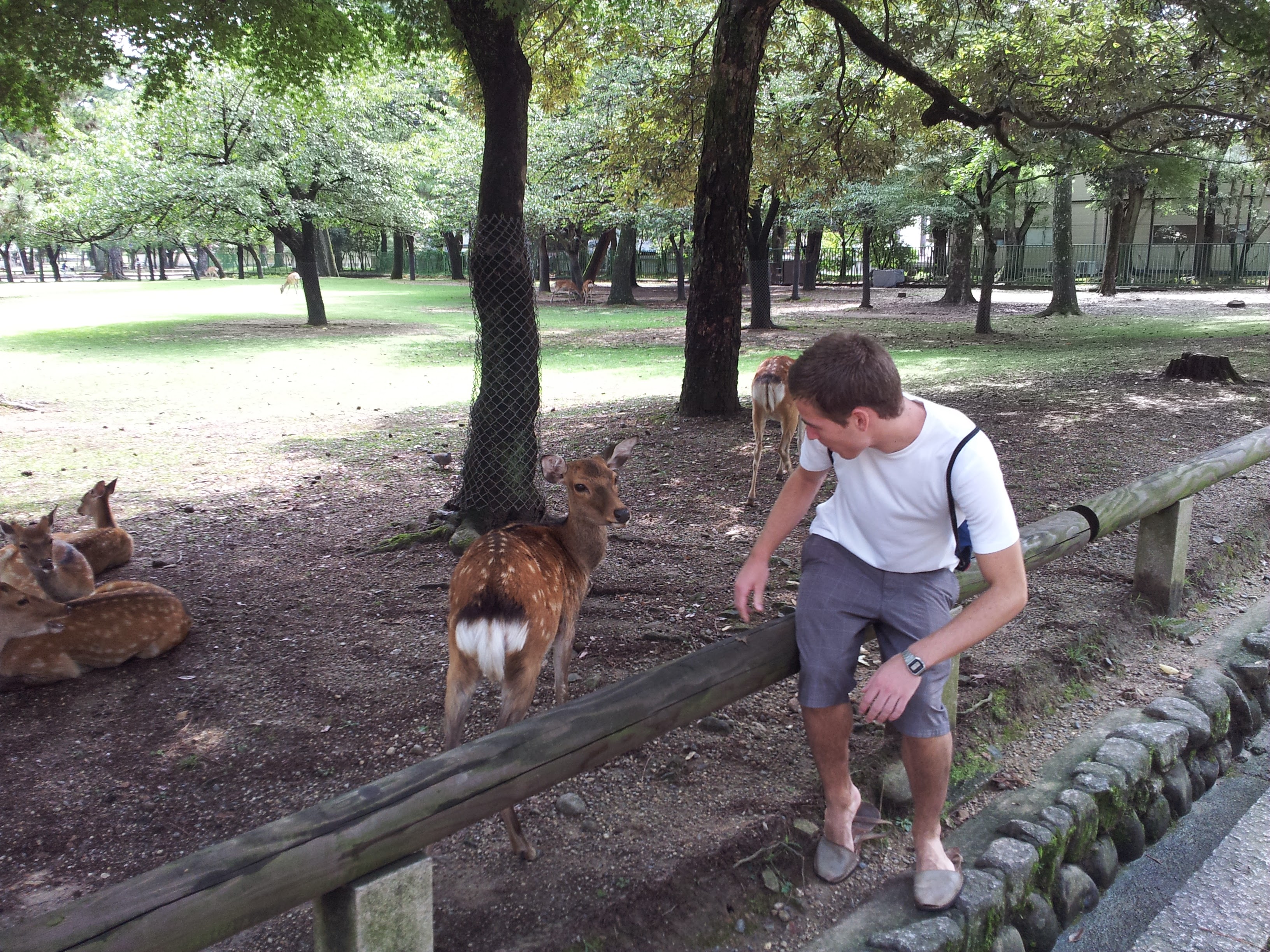
Shika senbei are bran crackers sold to feed the deer, available from vendors with carts around the park for ¥200 a pack. The deer know exactly what those crackers are. The moment you take out the packet, you may well find three or four deer around you trying to reach it.
Some deer have learned to make a small bow to ask for food, it’s genuinely charming. Others simply lunge at you if you take too long to hand it over. Young children can be startled; the deer don’t generally bite, but they headbutt when they want the cracker and they have reasonable strength.
A couple of practical warnings: don’t hide the cracker packet inside a bag that also has your own food, because the deer smell it. And if you’re carrying a plastic bag with anything in it, stay alert, the deer have learned that plastic bags often contain food.
September to November is the rut for male deer, when they carry their antlers and can be more aggressive. At peak season (October especially), the males’ antlers are trimmed as a safety measure, but in the early days of the rutting season it’s worth being more careful.
Tōdai-ji: the Great Buddha
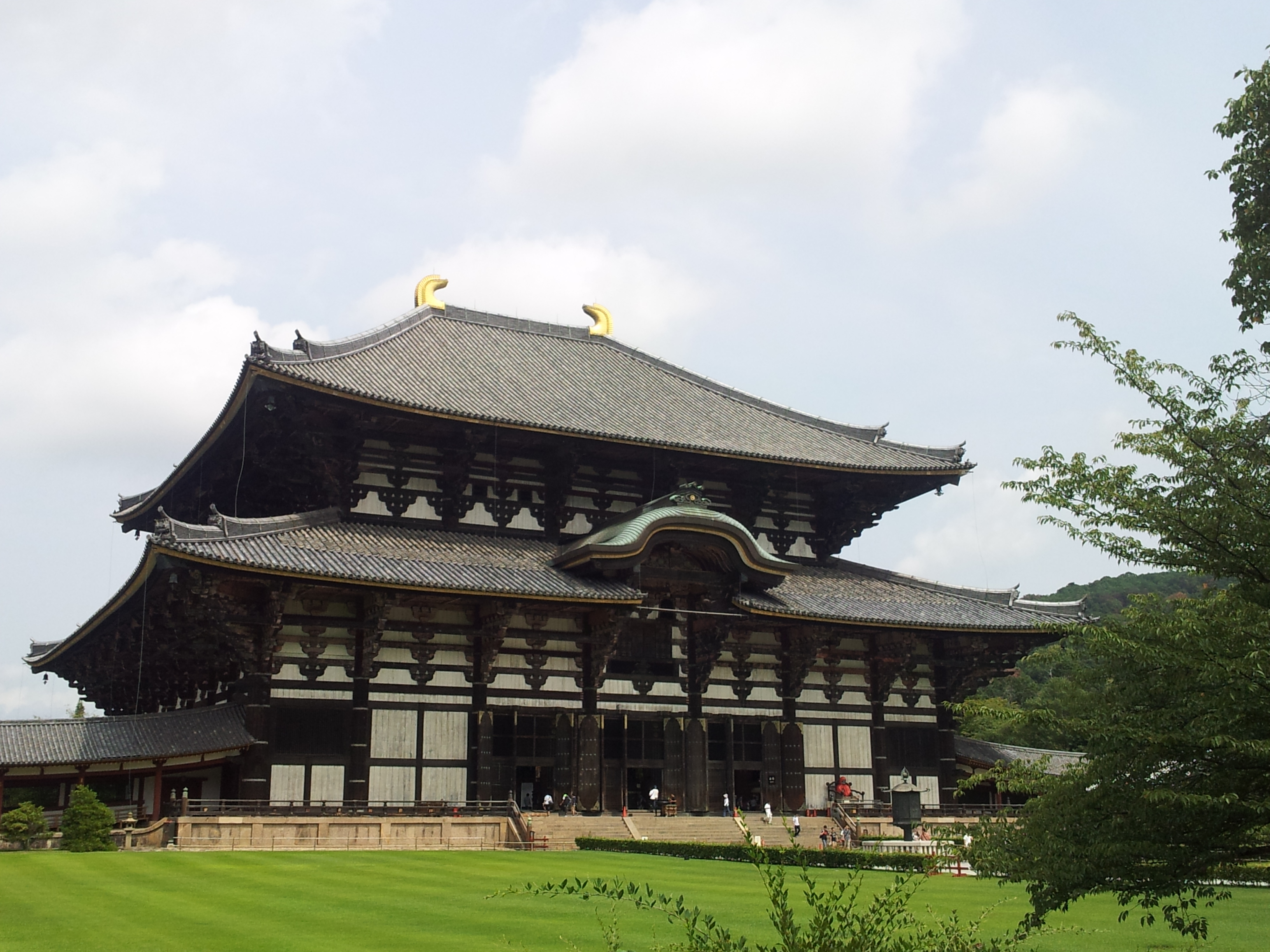
Tōdai-ji (東大寺) is the main reason to go to Nara if you can only choose one thing. The main building, the Daibutsuden (Great Buddha Hall), is the largest wooden building in the world, though technically it was rebuilt several times over the centuries and the current one (from the 18th century) is smaller than the original. It’s still enormous.
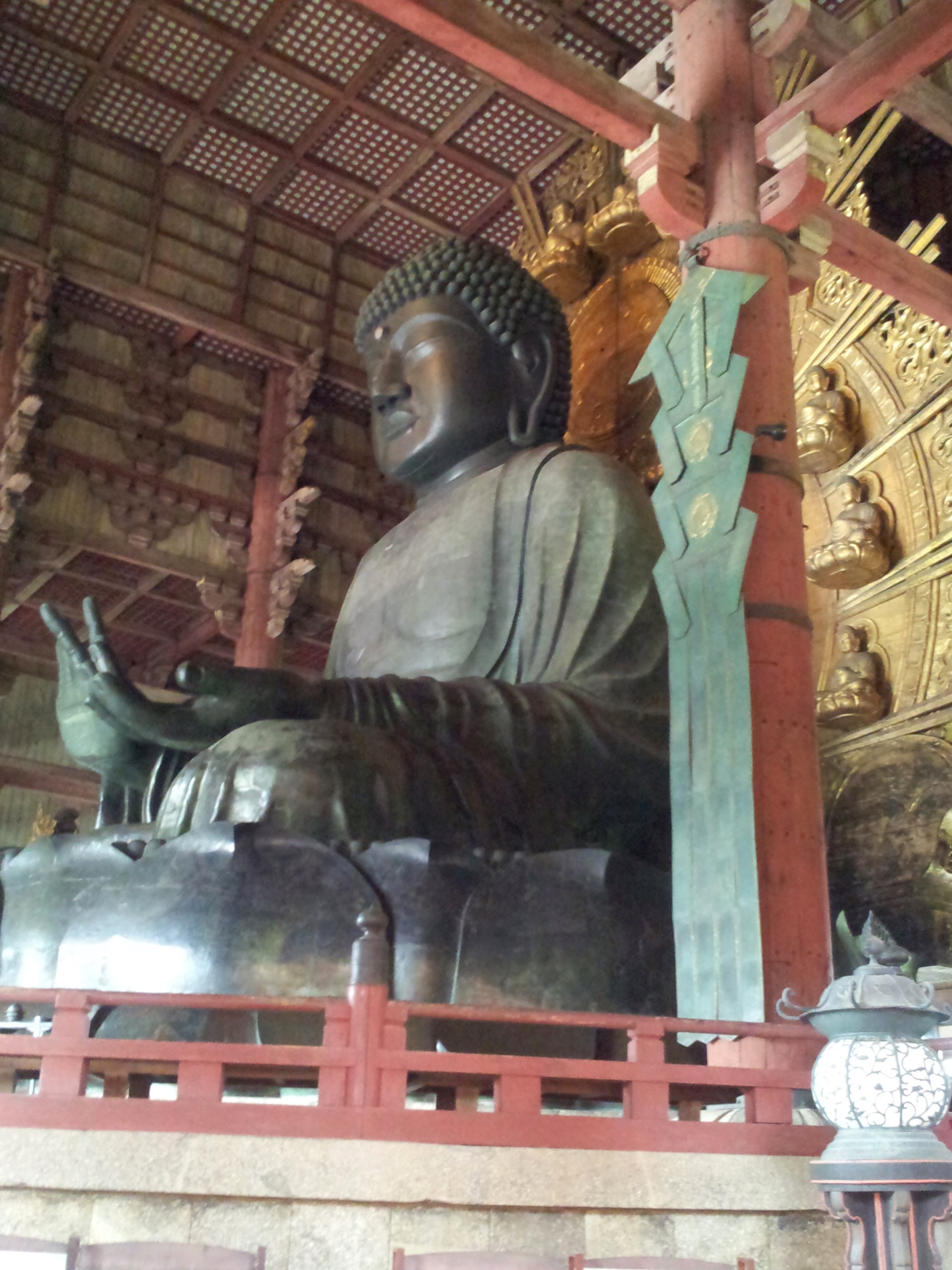
Inside is a 15-metre-high bronze Buddha statue that was cast in the 8th century. The scale doesn’t register until you’re standing inside looking up.
Entry costs ¥1,000 per adult. It’s worth it. The approach from the main gate (Nandaimon, with its enormous guardian statues) to the inside of the Daibutsuden is itself part of the experience, the park surrounding the temple with deer wandering between visitors is an image that stays with you.
There’s a wooden pillar inside the building with a hole at its base. Tradition holds that whoever passes through it, the hole is exactly the same size as the Buddha’s nostril, will attain enlightenment. The Buddha’s nostril measures approximately 37 cm × 30 cm, so it’s feasible for children and slimmer adults. It’s one of those absurdly Japanese moments that makes the trip worthwhile.
Kasuga Taisha
About twenty minutes’ walk from Tōdai-ji is Kasuga Taisha (春日大社), one of the most important Shinto shrines in Japan and a UNESCO World Heritage Site. The approach along the tree-lined path with its hundreds of stone lanterns is particularly atmospheric.
Entry to the outer precinct is free. There’s an inner garden (Hon-sha) with a paid entrance (¥500) and the Kasuga Taisha National Museum, but the atmosphere of the approach path already justifies the detour.
Naramachi and the rest
South of JR Station is Naramachi, a historic district with well-preserved Edo-period merchant townhouses, some converted into cafés or craft shops. It’s a good place to wander for an hour in the afternoon, when the park starts to empty out.
Local food includes kakinoha-zushi, sushi wrapped in persimmon leaves that act as a natural preservative, a speciality worth trying even if you’re not entirely convinced by the appearance. There are also several mochi stalls along the path to Tōdai-ji.
How long do you need?
Half a day is enough for the park, the deer and Tōdai-ji. If you add Kasuga Taisha and Naramachi, you need a full day.
If you’re coming from Osaka or Kyoto, you can arrive at 9am, see Tōdai-ji before the main wave of visitors arrives, walk through the park mid-morning when the deer are most active, and be back for dinner without rushing.
Going early makes a real difference. Tourist buses start arriving from 10-11am and Tōdai-ji fills up. At 8:30-9am the park is a different place.
FAQ
How much does visiting Nara cost? The park is free to enter. Tōdai-ji costs ¥1,000. Kasuga Taisha inner garden ¥500. Shika senbei ¥200 a pack. Budget around ¥2,000-3,000 in entry fees plus transport from Osaka or Kyoto.
Are the deer dangerous? Not generally. They can headbutt to ask for food and are persistent, but serious incidents are rare. More care needed with very young children and during the rutting season (Sept-Nov) with the males.
Can I go as a day trip from Tokyo? Technically yes, but you’ll be doing a lot of train travel. It’s better to combine Nara with Osaka and Kyoto on a longer trip through the Kansai region, for example as part of a 10-day Tokyo-Kyoto-Osaka itinerary.
Is it better in the morning or afternoon? Morning, definitely. The deer are more active, there are fewer people and the light is better for photos.
What’s the best time of year to visit? Spring (March-April) for the contrast between the park’s greenery and the cherry blossoms, and autumn (October-November) for the foliage. Summer is very hot with lots of people. Winter has fewer visitors and a quieter park, also valid.
Prices updated June 2026. Check Tōdai-ji’s opening hours before you go, it closes earlier in winter (5pm).
Related reading
If you found this useful, these guides go well with it:
Related calculators
About the author
Editorial entity
Yen & Zen is written by a Spanish-Japanese couple based in Kanagawa Prefecture, in the Tokyo metropolitan area. We have been in Japan since 2010. The site is a hobby project covering practical calculators and articles about life and travel in Japan, with verified figures and citations to official sources. We are not lawyers, accountants, or licensed advisors; articles here are based on observation, personal experience, and published official rules — not on professional consultation.